Wednesday, February 23, 2011

WAS ETHEL THE MAIN CAUSE OF THE KILLINGS?

I am rewriting this post following further consideration of the 'domestic' that seems to have occurred between Jimmy Governor and his wife Ethel at their camp at Breelong before he went and killed members of the Mawbey family.
At first I thought the argument they had was about Jimmy's younger brother, Joe, but now I believe that Ethel had told Jimmy she was leaving him.
Not for his younger brother, but because she was dissatisfied with the way she was having to live, without a proper roof over her head and enough food for her and their young son to eat.
"That night my wife and I had a word or two about cooking and something or another about the camp. With that I said, 'I suppose I am in this world alone with no one to care for me. I thought you was my wife.' She said, 'Go to the devil ...' I thought I may as well die, so the Mawbey murders were committed."
Jackie Underwood claimed that when they returned to camp after the murders, Jimmy and Joe had both wanted to kill Ethel and young Sidney, and that he had prevented it.
The fact that both Jimmy and Joe wanted to do it suggests that what Ethel had done had offended both of them, not just Jimmy.
Unbeknown to Jimmy, Ethel had had a foot in both camps, his and the Mawbey's.
She had been complaining to him about the negative comments the women at the Mawbey household had been making about her being married to an Aboriginal man.
But she had also been complaining to Mrs Mawbey about Jimmy and the way she was having to live as a result of being married to him.
This latter fact was revealed by the younger sister of Mrs Mawbey after the murders.
After the five-months pregnant Ethel and Jimmy had married in December 1898, the young couple had lived in a house next door to Ethel's parents in town.
When Jimmy got the 12-month fencing contract with the Mawbey's at Breelong, Ethel's parents and siblings moved to the nearby town of Dubbo.
It must have been hard for 17-year-old Ethel, a new mother of a 12-month-old son, to no longer have her own mother for support.
On top of that, she was living in a bark lean-to beside a creek several miles from the homestead.
At least she had some female company there, even if it was not very ameniable.
It would appear that the impressionable young woman was very much influenced by both Mrs Mawbey and the school teacher, Ellen Kerz.
According to Sarah Mawbey's younger sister who was living at Breelong at the time, Mrs Mawbey had told Ethel that if she wanted a proper roof over her head, instead of a bark lean-to,she had better find another man.
It would appear that this is what Jimmy was really angry about.
But his anger towards his wife who was threatening to abandon him was even more intense.
Jimmy appears to have experienced lots of betrayals in his life, and this was the last straw.
When he was in gaol in Sydney, he used to blame Ethel for making him kill the Mawbeys and the governess at Breelong.
Despite her youth, Ethel was not a passive victim of circumstances.
She could be spiteful and vindictive, and she gave Jimmy a hard time when he would not stand up to the women at the house in her defence.
At the time of the Mawbey murders, many people thought she was to blame, but she appears to have since been exonerated.
In my view, she was definitely a contributing factor.
But the true story of Jimmy Governor is not all black and white.

Wednesday, February 16, 2011

INSIDE THE AGE

The Age newspaper in Melbourne has published online some very interesting historical articles about the Jimmy Governor story.
These 'Snapshot Articles' contain information I have not come across before.
The link ishttp://inside.theage.com.au/view_bestofarticle.php?straction=update&inttype=1&intid=514

Saturday, June 19, 2010

DESCENDANT OF JIMMY'S LAWYER

Yesterday I met a great grandson of the lawyer who defended Jimmy Governor at his trial in Sydney.
He is the president of the Manly, Warringah and Pittwater Historical Society.
The solicitor's surname was Boyce.
Coincidentally I met Boyce's descendant at talk about Aboriginal artefacts, including tomahawks.
He pointed out to me that the government did not have to give Jimmy a trial because he had been declared an outlaw.
This meant he could be shot or hanged on sight.
Why the government gave him a trial is yet another of the many questions to be put and hopefully answered in this forensic blog.
The Boyce descendent also told me that the solicitor's father, a prominent member of the Anglican clergy, had been the founder of Barker College at Hornsby.

Friday, April 23, 2010

A LEGACY OF ABUSE ON MANY FRONTS

Reading about the brutal attacks on the Wiradjuri people by the white settlers and police in the Bathurst district in 1842 has helped me understand the psychological legacy carried by Jimmy Governor.
The whites had tried their hardest to annhilate his people after taking their land and its sources of food.
Unlike the whites, the Aboriginal people did not view the land in economic terms, as a means to make money and to get rich quick.
Their hearts and souls were intricately attached to it.
The land was their way of life.
The land was who they were.
But then as now, 'might' was 'right'.

I've been reading The Fatal Shore by Robert Hughes (1987) and have gained some insights into something else Jimmy would have been up against: being perceived as second class citizen as a farm labourer.
Because all the work on country properties was done initially by assigned convicts, native born white men shunned agricultural work because they did not want to be associated with 'them'.
This was despite the fact that many of their parents would have been convicts - 'them'.
Agricultural work was generally viewed within the colony as degrading.
As a result, a stigma against farm workers developed and may have still been in existence in Jimmy's time.
I have the impression that it was hard for John Mawbey to find labour to work on his properties.

Hughes says that the native born white men were also very 'clannish' and committed to 'mateship and class solidarity'.
Jimmy would have been excluded from white male society by this cultural factor too.
And also by the English class system that put everyone in their place, and which had also been 'transported' to Australia.

Monday, April 19, 2010

IRISH FITZGERALD ANCESTRY?

When I started this blog, I knew about the Fitzgerald family because I had lived in the Hawkesbury district where they were well known.
I wondered if Jimmy Governor's mother, Annie Fitzgerald, had been fathered by one of them.
None of my subsequent research found that she was.
Several convicts named John (Jack) Fitpatrick arrived in the colony, so one of them or one of their descendents may have been Jimmy's maternal grandfather.
I discovered that the Fitzgerald family provided a very interesting snapshot of life in the early colony of New South Wales.
For that reason I have kept the information I found about them and placed it on a separate page on this blog.
I am also providing some of this information here, to save any other researchers wasting time going down the same track.
Jimmy Governor was black and white ...
Jimmy, along with his five brothers and sisters, had Irish as well as Aboriginal blood flowing through his veins.
His mother, Annie, was the daughter of a full blood Aboriginal woman, Polly, and an Irishman, Jack Fitzgerald.
Jack was a stockman, according to Annie, who died before she was born.
Annie told police in 1900 that she had been born on Caigan station owned by a squatter, Andrew Brown, where her mother was a house servant.
She was raised by Polly and a male Aboriginal house servant, Henry.
Polly is said to have been a Wonarua woman from the Hunter Valley.
Caigan was on the Castlereagh River, about 10 miles from Mendoran.
Andrew Brown became very wealthy and was praised for his charitable activities.
[See: Governor family history page]
A wealthy Fitzgerald family owned properties in the Area ...
A convict who became a multi-millionaire after being transported to the penal colony, Richard Fitzgerald (1772-1840), owned large properties in the central-west of New South Wales, where Annie Fitzgerald was born.
He had arrived in Sydney with the Third Fleet and had three sons out of wedlock to his housekeeper, a married woman and fellow convict, Mary Ford, before marrying her in 1815.
The names of his three illegitimate sons were Richard Jnr (1805-22), Robert (1807-65) and John (1812-35).
Richard Snr was adept at managing people and found favour with a succession of governors who rewarded him with land grants.
Starting in 1824, he had acquired rich pastoral land on the other side of the Blue Mountains at Tongy (at Cassilis, later the township of Uarbry), Dabee (five miles east of Rylestone) and Wollar (a village near Mudgee).
The Fitzgerald family file in the Hawkesbury Library at Windsor reveals:
* In 1825 Richard Fitzgerald purchased 5000 acres of portion 1, Tungay, parish of Uarbry on Talbragar River, county of Bligh; [Perrett says it was given to him by Governor Bourke on 3-5-1825.]
* On 2 May 1830 Richard Fitzgerald said he had been on the Wollar land for about five years. [Perrett says the 1,000 acres in the parish Wollar in the county of Philip was given to him by Governor Brisbane on 28-2-1824]
* In September 1834, the Colonial Secretary's Office in Sydney recorded the sale of 790 acres to Richard Fitzgerald at Uarbry bordered by the Talbragar River;
* In 1838 Richard Fitzgerald had 25 assigned convicts on Wollar and three other holdings;
* In 1837, his son Robert Fitzgerald had 12 assigned convicts and one free man on his property, Mogadore, situated between the Talabragar River and Turee Creek;
The Fitzgeralds appeared to have a good relationship with Aboriginal people.
According to The Australian Dictionary of Biography's entry on Richard Fitzgerald: 'His republican and liberal sentiments taught him to treat the Aboriginals humanely, and they in turn led him to Tongy.'
It also says that in 1835, five years before his father's death, Robert Fitzgerald had done the right thing by the Aboriginal people when he had paid cash for the property, Yarraman to Bonegarley, 'King of Yarraman Plains'.
ROBERT MARSDEN FITZGERALD
Robert Fitzgerald Snr left his properties, Dabee and Tongy, to his eldest illegitimate son, Robert Marsden Fitzgerald, aged 30. [Source: Perrett].
Because he was named after his father, he would have been known as 'Jack'.
When I discovered the existence of this illegitimate son of Robert Fitzgerald in the Fitzgerald family history by Susan Perrett, I thought he might just have been the father of Annie Governor (nee Fitzgerald).

But he did not die young.
Perett says he was one of the first graduates of the University of Sydney and was admitted to the Colonial Bar in 1860.
He never married and when he died in 1910 aged 74, left a fortune of $76 million (2003 exchange rate)!!
If Annie was born in 1844, Robert Marsden Fitzgerald would have been 9; in 1850, 15; and in 1857, 22.
Perett says he spent his life managing the 15 station properties the family owned.
It is possible he may have worked as a stockman for his father when he was a young man.
It seems that the only way of ascertaining whether or not he was Jimmy's maternal grandfather would be to DNA test descendents of the Fitzgerald and Governor families.
BUT ...
On the death certificate of ANNIE FREE (nee GOVERNOR) it is recorded that her father's name was JOHN.
Was it 'John' Fitzgerald, not 'Jack'?
Deaths of two men bearing the name John Fitzgerald are recorded in 1846 and 1854 in New South Wales.
Neither of these dates agree with Annie's story about him dying within the nine months before she was born (1844, 1850 or 1857).
In November 1840, a John Fitzgerald was a stock-keeper on a station called Yarrabembarra owned by a Mr Oakes.
This property was about 40 miles from Bathurst and 70 miles from the Lachlan River.
He had been a witness to a murder of the other stock-keeper there, John Dillon, by an Aboriginal man called 'Neville's Billy'.
Dillon, 31, had been speared while trying to shut the door to his hut to prevent the perpetrator from coming inside for food.
Perhaps Fitzgerald had decided to look for another job after this and found one at Caigan.
In October 1848, a John Fitzgerald had a property called Mylora (aka Grylora) on the Lachlan River.
AND ...
Richard Fitzgerald had a son named John, but he died in 1835 aged 23.
Annie died at Brewarrina in 1915.
She and her family had been forcibly moved there from Wollar near Mudgee during the murderous rampage of her two sons in late 1900.
Authors, Moore and Williams claim that she is buried on a property where the young Governor family once lived, with her young daughter.
This may have been Alice, Jimmy's older sibling
Postscript
The NSW Births Deaths and Marriages has recorded in its registry a death of an ANNIE D GOVERNOR at Cootamundra in 1917.
The given name of her father is JOHN.
I do not know who she is, where she fits into the big picture.
Reference: From Convict to Millionaire - The Story of Richard Fitzgerald and family (2003), by Susan Perrett, self-published, Victoria.


WIRADJURI WARRIOR

In order to discover who the real Jimmy Governor was, I must find out more about his Aboriginal ancestry.
Jimmy is said to have been a Wiradjuri man.
The Wiradjuri are described as 'warriors' by Aboriginal people I have spoken to recently.
The only information I have been able to find about the Wiradjuri so far is on the Mudgee District Local History website http://www.mudgeehistory.com.au/
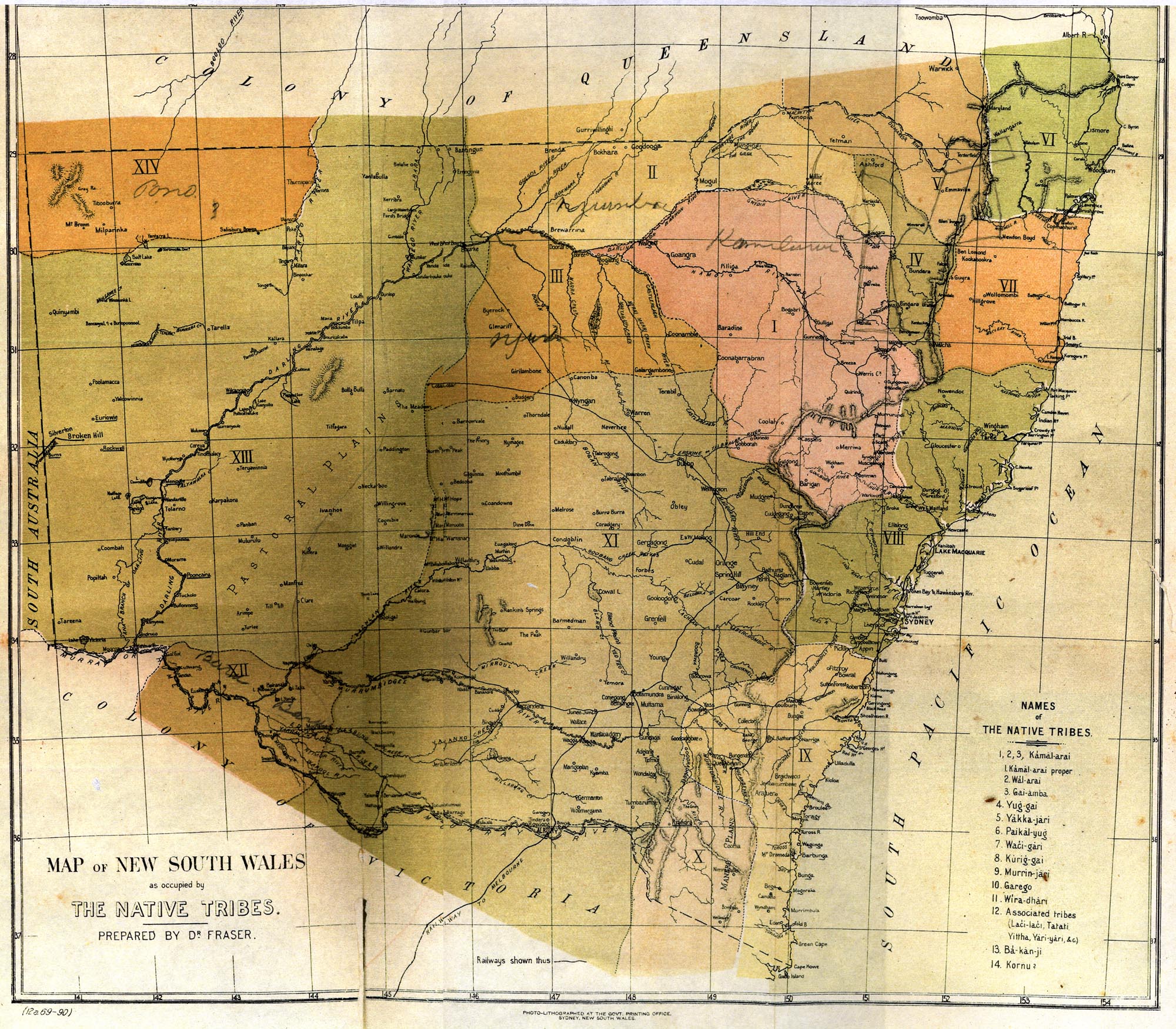
After perusing this website, I have learnt that the Wiradjuri nation covered a vast area in the central west of NSW.
Their first contact with white settlers was in the Bathurst area, who began to arrive in their territory after the crossing of the Blue Mountains.
At first the Wiradjuri people were peaceful towards the new arrivals.
But after they realised the intruders were taking their best hunting land and being disrespectful towards their sacred sites, they turned on them.
By 1824, an outright war between the blacks and whites had broken out with many retaliatory killings on both sides.
The then Governor, Thomas Brisbane (successor to Governor Lachlan Macquarie), declared martial law and permitted the Wiradjuri to be killed with impunity.
This 'open season' on Aborigines went on for four months, from August to December 1824.
This was the beginning of the end for the Wiradjuri.
By the time Jimmy Governor embarked on his own retaliatory 'pay back' campaign some 75 years later, his Wiradjuri relatives were living on a mission at Wollar.
But his battle was not about land rights.
It was about 'pay back', righting the wrongs done to him by other people, including members of his own extended Aboriginal family.

Wednesday, April 14, 2010

FOOT IN BOTH CAMPS

It's a fact of life that we can all rub somebody else up the wrong way.
And that a group of women living together under the one roof can be bitchy, particularly towards other women they view outsiders, and not one of them.
Jimmy Governor's wife, Ethel Page, complained in court that she had been subjected to that type of mistreatment by the Mawbey women and the school teacher, Ellen Kerz.
These women had behaved badly towards a couple of other female school teachers who had boarded at Mrs Mawbey's house before Miss Kerz arrived.
In the case of Ethel Page, being a white woman living in a blackfellow's camp beside a creek would have been well and truly beyond the pale for women who viewed themselves as being well brought up 110 years ago.
But a couple of other female school teachers at Breelong had complained to the Department of Public Instruction about their ill treatment by Mrs Mawbey.
The first, who had boarded in Mrs Mawbey's house, had resigned on the ground of ill health because of difficulties she had experienced.
The second, a Miss Squires, moved out of Mrs Mawbey's house and went and lived with another family, much to the chagrin of Sarah Mawbey.
She was so put out, that she refused to supplement the salary paid Miss Squires by the Department of Public Instruction, as she and the other parents with children at the school were required to do.
The next school teacher, Mary Edwards, did not board at the Mawbey's at all and only stayed at Breelong for a short time.
I have been in a similar situation myself.
At the retirement village where I live, there is a small group of women who look down on me because they think I am not of the same social class as them.
They make it very obvious and therefore very hard to ignore.
So I can put myself in the shoes of Ethel Page, and to some extent, her husband Jimmy, who had to constantly bear these slights.
In those days there were no counsellors to go and talk to about it like there are now, to alleviate some of the resentment that builds up around being treated in this snobbish way.
Like Jimmy, I am part of a group that is generally looked down upon in Australian society, a public housing tenant, so this too gives me some understanding of his situation.